


2026 St Andrews Open: McColgan masters the wind at the Eden
From the Locker Room
Sunday, 12 April 2026
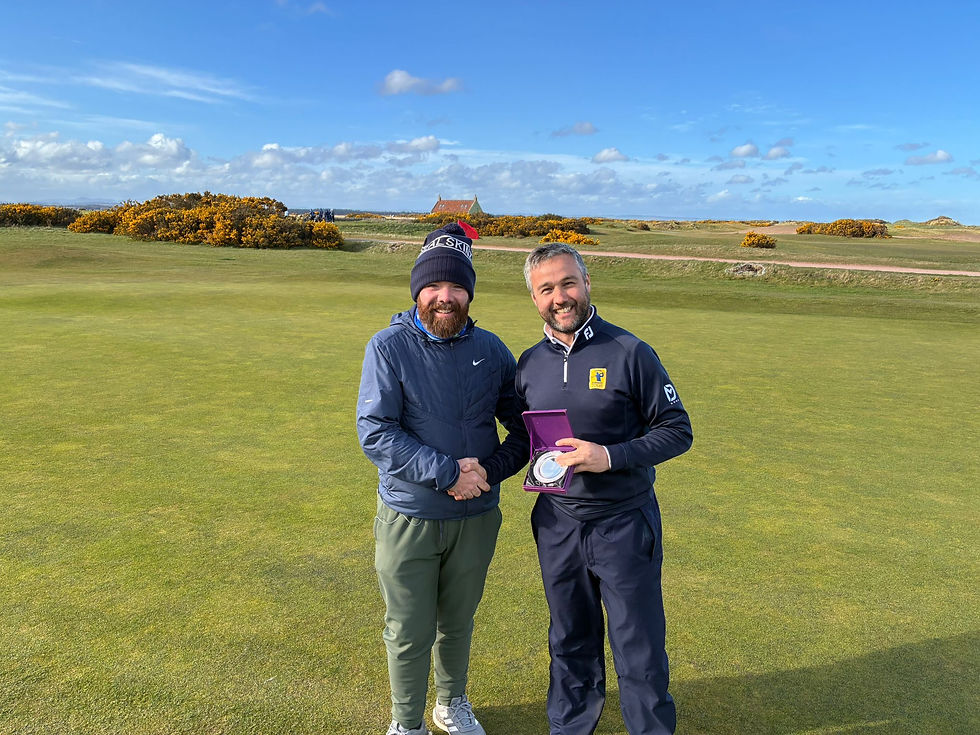
There is a moment, late in every St Andrews Open, when the noise fades.
It doesn’t disappear completely — not on the St Andrews Eden Course, not with wind tearing across the fairways and scorecards tightening in the players’ hands — but it softens. The chaos gives way to clarity. The tournament, which for hours has felt like a battle of survival, suddenly becomes something simpler.
Execution.
In 2026, that moment arrived on the 17th tee.
And as David McColgan stood over his ball, the entire tournament — the wind, the pressure, the mistakes of others, the patience of his own round — distilled into a single thought.
“You know it’s coming,” he would say later. “As soon as you turn at 15 it’s staring at you up the hill.”
This time, though, something was different.
________________________________________
The Conditions That Define the Truth
The St Andrews Open does not always reveal itself so cleanly.
But on this April morning, it did.
A 25mph westerly wind cut diagonally across the Eden — the most awkward of directions, the kind that turns simple decisions into debates and good swings into uncertain outcomes. The range offered little warning. Balls flew straight, obedient, almost benign.
Then the first fairway arrived.
“Once I was out on the first fairway, I knew the wind was going to be a factor,” McColgan said. “On the range the wind felt like it was coming from a different direction… but out there, it was completely different.”
It always is.
That is the first lesson of the Eden — and perhaps its most important. It does not play the same twice. It asks you to adjust, constantly, subtly, relentlessly.
And on days like this, it strips the game back to its essentials.
“When you are playing in that condition,” McColgan explained, “the most important thing is not to compound errors and make sure you leave the ball in a position to score.”
Not brilliance.
Position.
________________________________________
The Round Before the Round
Long before the final three holes — long before the birdies, the momentum, the inevitability — this tournament was being shaped somewhere else entirely.
The front nine.
Or more specifically, the stretch from the 2nd to the 8th — the part of the Eden that quietly decides who will still be relevant by the time the round turns.
“The tournament is never won in the front nine,” McColgan said. “The 2nd hole has one of the toughest approaches on the whole course, 3 is fraught with danger, 4, 5, 7 and 8 is a tough loop… so I knew if I could play steady through there I’d score pretty well.”
This is not guesswork.
It is borne out in the data.
Across years of scoring, the Eden compresses players early. It does not allow separation. Instead, it introduces pressure — small, cumulative, unavoidable. The 3rd has ended tournaments before they have begun. The 7th destabilises rhythm. The 8th punishes imprecision.
In 2026, those patterns held.
Stuart Allan’s challenge unravelled at the 7th — a 9, driven by five shots from a greenside bunker. A single hole, but one entirely consistent with his historical vulnerability there.
Kevin Brannan suffered even earlier — an 11 at the 3rd, a hole that, statistically, has long been his undoing.
The Eden does not surprise you.
It exposes you.
McColgan understood that.
And so, while others tried to find momentum, he did something simpler.
He removed risk.
________________________________________
The Blueprint in Plain Sight
There is a tendency, in golf, to talk about strengths.
Ball-striking. Putting. Shot-shaping.
But the data from the St Andrews Open tells a different story.
The winners are not those with the most strengths.
They are those with the fewest weaknesses.
McColgan’s record here is not defined by brilliance. It is defined by absence — the absence of spikes, the absence of disaster, the absence of any single hole that holds him hostage.
“I always start with the position of taking double bogey off the table,” he said. “How do I strike the ball off the tee, giving me the best opportunity to shoot bogey or better.”
It is a deceptively simple idea.
But it is the entire blueprint.
Because on a course where the field clusters — where 74 to 79 becomes the natural scoring band — the difference is not made by birdies.
It is made by what you avoid.
________________________________________
The Middle Stretch — Where Tournaments Quietly End
If the front nine sets the stage, the middle of the round decides who remains in it.
Holes 10 through 14 at the Eden do not announce themselves dramatically. There are no iconic visuals, no famous landmarks, no singular danger zones.
But the data reveals their truth.
They are the erosion phase.
This is where rounds drift.
This is where players lose contact without quite realising it.
In 2026, McColgan made his only real concession here — bogeys at 11 and 12. On another course, or another day, that might have been the start of something worse.
But the Eden teaches patience.
“In the front group it does make the leaderboard look more daunting,” he admitted. “However, I knew if I struggled through it, the field would likely slip up too.”
And they did.
Because this is what the data shows, year after year: The Eden does not punish everyone at once.
It waits.
It distributes mistakes across the field, one by one, until the leaderboard is shaped not by surges, but by survival.
“Once the ball is in the hole,” McColgan said, “the only thing to think about is the next one.”
That is not a cliché here.
It is a requirement.
________________________________________
The Illusion of Momentum
Golf is a sport obsessed with momentum.
But the St Andrews Open has always resisted that idea.
There is no obvious scoring stretch. No sequence of holes where players can reliably make gains. The course does not offer runs.
It offers moments.
“A lot of players talk about momentum,” McColgan said. “But you’ve got to manage the course at every turn, and know when the opportunity presents itself for a score.”
This is where so many rounds come undone.
Stuart Sutherland had done everything right. Stayed in touch. Managed the conditions. Avoided disaster.
Then came the 15th.
A green in regulation. A routine par opportunity. And then — a four-putt.
A single lapse.
At the Eden, that is enough.
________________________________________
The Closing Stretch — When the Course Finally Opens
And then, finally, the shift.
The wind turns.
The angles change.
The course — for the first time all day — offers something back.
This is the paradox of the St Andrews Open. For fifteen holes, it demands restraint.
For the final three, it asks a different question.
Do you recognise the moment?
McColgan did.
“When the birdie went in on 17 I certainly felt I was putting myself in a good position,” he said. “It’s hard not to sense the gravity of a strong run like that… and I just tried to ride the positivity into 18.”
But the story of that stretch begins one hole earlier.
The 16th — a par 5 that, in the right wind, becomes a genuine opportunity. McColgan took it.
Then came the 17th.
________________________________________
Seventeen — The Hole That Confirms Everything
There are holes that exist within a course.
And there are holes that define it.
The 17th at the Eden belongs to the latter.
Its reputation is built on narrative — out of bounds right, pressure, collapse — but the data confirms it. It produces the highest variance across the field. It is where tournaments end.
For Scott Gowens, it did again in 2026 — an 8, entirely consistent with a historical average that marks the hole as a recurring weakness.
For McColgan, it was something else entirely.
“Today was different,” he said. “It’s the first time we’ve played that hole with the wind at our back and helping off the right, pushing you away from OB.”
A subtle shift.
But one that changed everything.
“Today I stood up and just swung with confidence… and when the ball sailed straight up the middle of the fairway I was down picking up my tee and off after it.”
It is a small image.
But it tells the whole story.
Confidence not forced.
Confidence earned.
________________________________________
The Final Stroke — And What It Means
By the time he reached the 18th, the outcome felt inevitable.
Another birdie.
A closing stretch of three-under.
A round transformed from controlled to commanding.
But this was not a late surge.
It was the natural conclusion of everything that had come before.
Because the St Andrews Open is not won on the final three holes.
It is won by reaching them intact.
________________________________________
The Champion’s Awareness
There is one final element to McColgan’s performance that the data alone cannot fully capture.
Perspective.
“I saw Stuart Allan’s bunker woes,” he said. “It’s hard to watch… but I also knew it was early in his round.”
There is a temptation, in tournament golf, to react — to the leaderboard, to the noise, to the mistakes of others.
But the Eden punishes that too.
“It’s really hard to keep tabs on players,” he said. “So you’ve just got to manage yourself really and control what you can control.”
That is the final piece of the blueprint.
Not just control of the ball.
Control of the mind.
________________________________________
A Familiar Beginning — And a Long Road Ahead
The St Andrews Open is the first step in a long season.
It does not decide the James Braid Quaich.
But it does shape it.
“I’ve won the event four times now,” McColgan reflected. “And it’s always great to stake a claim for the top of the Order of Merit early.”
There is no complacency in that.
Only understanding.
“But it is a long season,” he added. “There will be loads of twists and turns before the winner is declared at Craigielaw.”
And yet, for all that uncertainty, one thing already feels clear.
“I think most people know my disappointment from the end of last season… and I make no mistake in saying I’ll give it my all to win back the Quaich.”
________________________________________
Final Reflection — The Simplicity of Mastery
There is a tendency to overcomplicate golf.
To search for secrets, for hidden advantages, for moments of genius that separate winners from the rest.
The St Andrews Open offers a different lesson.
It is not about genius.
It is about discipline.
It is about structure.
It is about, as McColgan put it, “taking double bogey off the table.”
On a day when the wind howled, when others faltered, when the Eden exposed every weakness it could find, one player followed that principle more completely than anyone else.
And in doing so, he didn’t just win the tournament.
He showed everyone else exactly how it is done.