


2026: St Andrews Open: Players' Reactions
From the Locker Room
Sunday, 12 April 2026
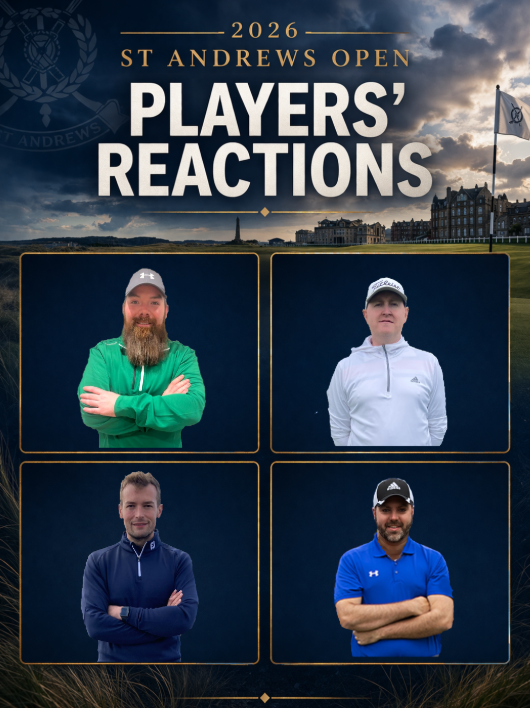
There are days when a golf tournament is decided by brilliance and then there are days like this — when it is decided by restraint.
The 2026 St Andrews Open, played under a bruising 25mph westerly wind and intermittent squalls of frozen rain, was not a stage for flair. It was a test of judgement, of discipline, of the ability to accept what the course would allow and resist the temptation to force anything more.
At the St Andrews Eden Course, that distinction has always mattered.
On this day, it decided everything.
And if the leaderboard tells you who finished where, the voices of the players tell you something far more revealing — how it actually unfolded.
________________________________________
Graeme Connor — The Round That Got Away
For Graeme Connor, the story of St Andrews was not one of struggle, but of precision interrupted.
A 75 in those conditions was, on the surface, a strong performance — a score that kept him firmly within the conversation for much of the day. But for Connor, the number carried a sense of what might have been.
The damage came early.
“I lost a ball innocuously on 2 and 3,” he reflected, “and I think I three-putted four of the first five holes.”
It was not a collapse in the traditional sense. There was no unraveling, no sequence of compounding errors.
Instead, it was something more frustrating — a series of small disruptions that, taken together, altered the trajectory of the round before it had truly settled.
And yet, what followed was perhaps more telling than what came before.
“A third of the way in I just got more settled with the conditions,” he said. “I began to figure out how the wind was affecting my ball.”
From that point on, Connor’s golf was controlled, deliberate, and — crucially — repeatable. He leaned into a strategy that defined the entire tournament: accept the conditions, manage the course, and remove risk wherever possible.
“It was very much a day for solid course management rather than spectacular golf.”
That approach worked.
But not quite enough.
Because when Connor reflects on his round, he does not see the steady middle stretch. He sees the margins.
“Had I just bogeyed those three early holes,” he admits, “I would have won.”
That is the nature of the Eden in these conditions. Not every mistake is punished equally. But the ones that come at the wrong time — early, before the round has stabilised — carry a weight that lingers long after they are made.
________________________________________
Kevin Brannan — The Cost of One Moment
If Connor’s round drifted away early, Kevin Brannan’s was defined by a single, brutal moment.
The 3rd hole.
“I stood on the tee having seen Craig Miller slice one OB,” he said. “That didn’t do much for the nerves.”
What followed was a sequence that will sit uncomfortably in the memory.
“I then sliced two on a left-to-right wind OB onto the Old Course. It didn’t get better from there.”
In calmer conditions, such a hole might be recoverable. At the Eden, with the wind whipping across the fairways and the margin for error reduced to almost nothing, it becomes something else entirely.
It becomes definitive.
From that point, the round shifted from ambition to survival.
“Not long after that, my objective was not to come bottom of the leaderboard… avoiding the worst score in Tour history became the focus.”
And yet, within that recalibration, something interesting happened.
Clarity.
“Once I settled in and got to grips with the wind, I found the groove.”
The back nine, in contrast to the chaos of the front, was composed, controlled — even impressive. His putting, in particular, stood out.
“Other than the first hole, I putted really well… my lag putting was great.”
It is a reminder of something often lost in the raw numbers of a scorecard.
Rounds are not uniform.
Even within a difficult day, there are elements to build on.
For Brannan, the takeaway is not the number.
It is the lesson.
“In a wind like that… my three wood is a greater friend than my driver.”
At the Eden, understanding that difference is everything.
________________________________________
Stuart Sutherland — Control, Then a Moment Lost
For Stuart Sutherland, the St Andrews Open was something closer to a blueprint — almost perfectly executed, until it wasn’t.
“I made the decision early to keep it simple and try and keep the ball below the wind,” he explained. “It might have looked unconventional, but it seemed to pay off.”
It did more than that.
For much of the round, Sutherland appeared in complete control. His strategy was clear, his execution disciplined, his mindset aligned with the demands of the day.
“I was just looking to try and play bogey golf,” he said. “Anything better than that was a bonus.”
It is a deceptively simple philosophy. But on a day like this, it is precisely what the course demands.
The front nine passed under that control. The round built steadily. Momentum gathered, quietly.
And then, without warning, it faltered.
“Lapse of concentration,” he said simply. “Two really stupid close putts thrown away out of nowhere.”
There is something almost cruel in that phrasing. Not a misread. Not a misjudged line. A lapse.
In a round defined by discipline, it was the smallest break in that discipline that proved decisive and yet, even in reflection, there is no sense of regret overwhelming the performance.
“I’m pleased with how I played and picked my way around the course,” he said. “Not playing as frequently as I do, that was the most pleasing thing.”
Sutherland’s takeaway is not rooted in the missed opportunity - it is rooted in understanding.
“I feel like I’ve got a better understanding of how to play it in the wind.”
At the Eden, that knowledge is as valuable as any score.
________________________________________
Callum McNeill — Close, But Not Quite There
For Callum McNeill, the St Andrews Open was something more ambiguous.
A round that showed progress and exposed the final step still to be taken.
“I’ll take it and move on in those conditions,” he said. “The scoring was actually better than I expected.”
For a time, it looked like it might be more than that.
“At the turn I was one back and felt it was time to make a move.”
That moment — the decision to shift from control to attack — is where the Eden reveals its true character.
“I then reeled off about six gross bogeys in a row.”
Not through recklessness, necessarily. Not through a single catastrophic error. But through the accumulation of small misjudgements, each one amplified by the conditions.
“It’s harder to judge downwind,” he explained. “I left a couple short… worried about flying it long into the gorse.”
That tension — between aggression and caution — sits at the heart of the course. McNeill has, by his own admission, been working to remove the bigger mistakes from his game.
“I’ve been trying hard to avoid big numbers and take sensible options.”
But in doing so, he recognises the risk of going too far in the other direction.
“I’ve maybe went a bit too far that way and need to mix a bit of reckless abandon back in.”
It is a fine balance.
And it is one that defines the difference between competing and winning.
“I’m not far away,” he said. “There’s not many events now that I turn up to and think ‘no chance’.”
At this level, that belief matters.
But belief alone is not enough.
________________________________________
Final Reflection — The Day the Course Won
What ties these performances together is not the scores themselves, but the themes within them.
Control.
Patience.
Understanding.
Every player, in their own way, arrived at the same conclusion - this was not a day to chase, it was a day to manage.
Those who did so successfully — most notably David McColgan — found themselves at the top of the leaderboard.
Those who didn’t, even briefly, found the margin for recovery was almost non-existent.
Because on the Eden, in conditions like these, the difference between a winning round and a chasing one is not measured in brilliance.
It is measured in decisions.
And on this day, more than most, every decision mattered.